


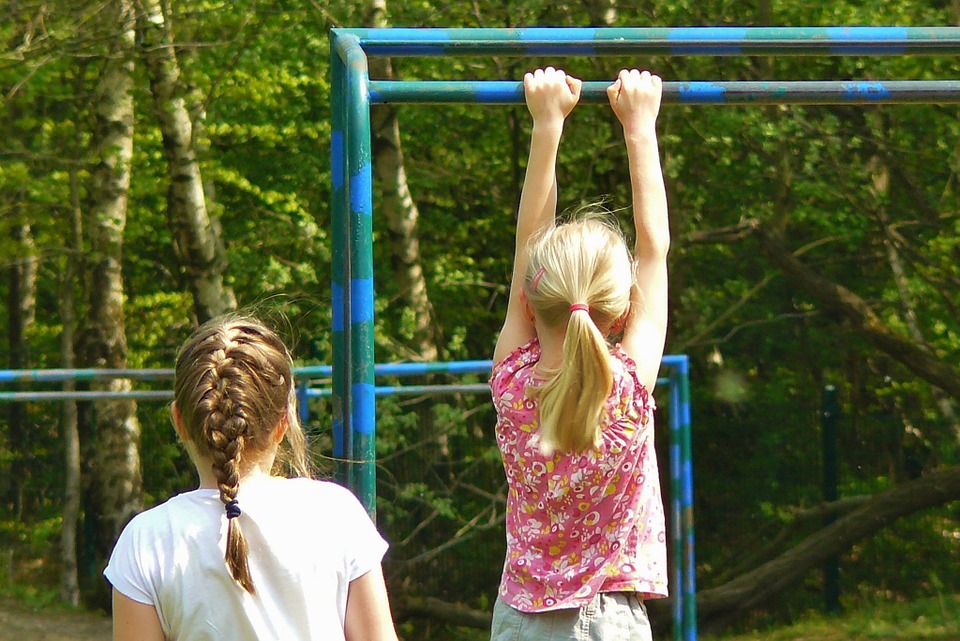
A is for apple. B is for ball. M is for Monkey Bars that help you sit up tall! Would you have thought, as you watch your child swing from bar to bar, that he is preparing to learn to write? The idea seems almost ludicrous – ‘but he’s just playing!’ we can almost hear every parent say, ‘he’s learning to write in school, at his desk, like all the other children!’ Perhaps that is where he is learning how to write, but all the preparation for being able to write is happening on the playground.
There is a natural sequence to how a child develops coordination and muscle control, starting from the top of the head and down towards the toes, from the centre of their body and out towards their fingers. This ensures that their core and gross motor skills are well developed before beginning to master the intricate combination of muscles, bones and ligaments used when exercising fine motor skills, the precise movements needed for writing.
So in order to be able to write, a child’s upper body must be strong enough so that she sits or stands in an upright position; her shoulders must be strong and flexible enough to support and move her arm; her upper arm needs to be able to mover her lower arm towards the page; her lower arm needs to provide solid support to rotate her wrist; her wrist needs to control the rotation of her hand; and finally, her fingers must be able to firmly grip a pencil, and carry out the movements of writing. From this we can see how important it is to fully develop all of the muscles in the sequence.
Children tend to hang by their hands whenever the opportunity arises. Besides fulfilling their need for play and fun, doing this benefits the child by decompressing the spine and opening up the back to allow the lungs to fully inflate and contributes toward forming the correct posture.
We may not want to be compared to primates, but we are talking monkey business. So just like their young, newborn human babies have remarkable strength in their hands, and many can support their full weight. The difference between other primates and humans is that we treat our babies as weak and completely helpless, while the babies of other species need to cling to their mothers as she moves about. In our modern world, babies are over-cossetted and normal abilities are lost or hampered, which is seen with such increasing frequency it has even been given a name: the “Containerisation Syndrome.”

When using the monkey bars, children follow a typical sequence: first they hang by their hands, then they reach for the next rung using their dominant hand, and then the other hand. They then progress to hand-over-hand and finally skipping rungs, which is called brachiating. Jay Beckwith, known to many as the “father of the modern playground” says that when we remove parts of the normal sequence that children try to complete, we stunt their natural development and this is often the case where we see children falling of play equipment and getting hurt – something which has caused major disputes between those advocating for children’s rights to play, and those opposing modern playground equipment for safety concerns.
Just how do the monkey bars and other playground equipment help your child progress towards being able to write? By climbing, hanging and swinging, your child’s core muscles and upper body are gaining strength. When twisting, dangling and turning, they develop flexibility that helps with rotating their arms. Pulling, pushing and lifting themselves builds strength and the concepts of weight, pressure and resistance. So if you want to give your children the best possible start in their journey towards writing, get them outdoors and onto the playground.
Resources:


