


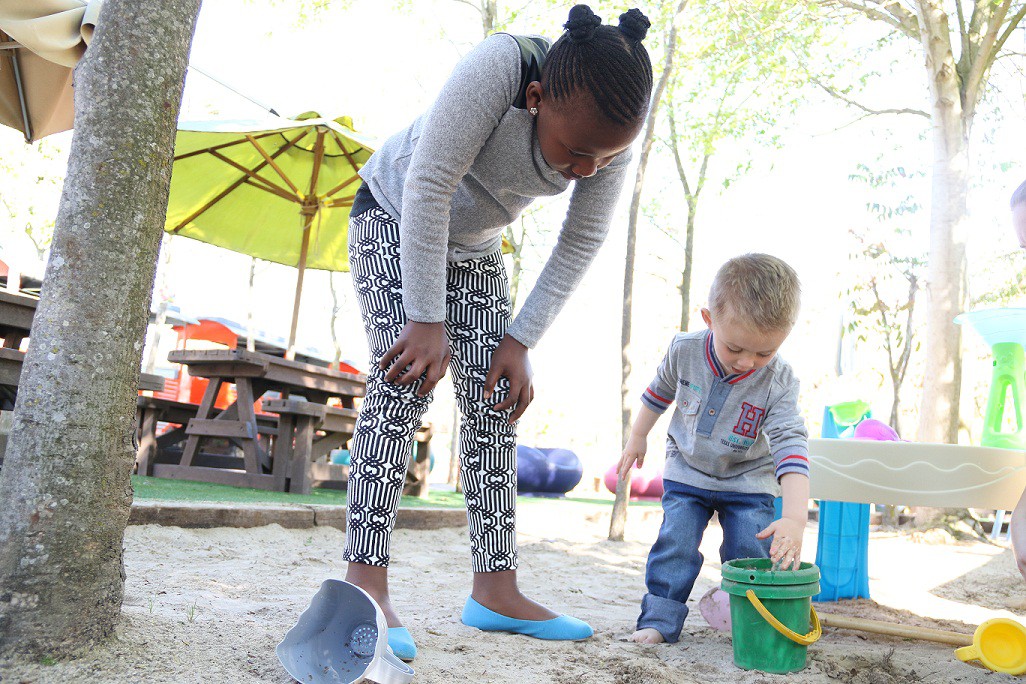
With summer on its way, it’s time for child’s play to head outdoors where shoes are discarded, winter complexions are replaced by sun-kissed rosy cheeks (don’t forget the sunblock) and hair ruffled by a cool afternoon breeze. It’s time to bring out the buckets and spades, remove the cover from the sandpit and fill up the water table. It’s almost inevitable that summer brings sandy toes and muddy fingers and with this the birth of brand new learning opportunities for first time- and seasoned sand-players alike.
For parents, once we understand the benefits of sand play, children building sand castles may seem like a chicken and egg question… which comes first – having fun, or developing skills? A popular quote by Henry David Thoreau goes: “First build your castles in the sky, and then put the foundations under them.” And so it is with sand play – through creating a safe environment for our children to play, we are also providing the tools they need to form a solid base for their development and learning through the many benefits of playing with sand.

Benefits of Sand Play
Sandra Crosser, Ph.D., an associate professor at Ohio Northern University says: “Because sand play is open-ended, the child determines the direction and path of his or her own play… There is no right way to use sand. It invites participation; it permits children to make and test hypotheses; it stretches the imagination; it provides a potentially soothing sensory experience; and it is an excellent avenue for children to learn physical, cognitive, and social skills.”
Sensory Exploration
Sand presents a unique texture for children to compare with others they encounter in every day play. Its granular texture contrasts the smooth surface of wood; the powdery grains of dirt; the rough, hard sensation of concrete; or the soft, prickling grass beneath our feet.
Gross and Fine Motor Skills
Gross motor skills develop as children scoop, dig, sift and pour sand; while fine motor skills and eye-hand coordination improve through using their fingers to draw or write in the sand and manipulate implements.
Social Skills
When children play together in sand, they learn to share, negotiate, compromise and problem solve. They need to see another child’s perspective, discuss their joint and individual creations; and create, and obey, the rules of play.
Language and Communication
Introducing a variety of accessories for playing in the sand provides opportunity to increase vocabulary. When children play together in sand, they need to speak and listen, which develops language skills.
Maths Skills
Playing with sand presents opportunities to learn concepts like more/less, heavy/light, empty/full, bigger/smaller and many/few. Balancing scales, measuring spoons, cups and a variety of containers in different sizes used in sand play develop mathematical skills.
Science Skills
Children develop an understanding of scientific concepts when they use ropes and pulleys to move buckets of sand; watch sand sift through various containers; pour sand into a water wheel; add water to the sand; or use other implements to experiment with sand.

Sand Safety
As with any type of play, safety should always be top priority when children engage in sand play. Whether it is at home, on the playground or at the beach, there are some basic guidelines to keep in mind.
At the Beach
- Make sure you visit a beach known for being clean and free of litter. Hidden objects in the sand; or other forms of pollution are a hazard to your child’s safety and health.
- Remember to put sunscreen on your children before they take to the shore – sand and water reflect the sun, so even short periods of sand play without sun protection can lead to tender skin later in the day.
At Home or at the Playground
- Sandboxes should be covered when not in use to keep animals from turning them into litterboxes.
- Wet sand can be a breeding ground for parasites, so make sure sand is kept clean, dried and aired by raking regularly.
- Teach your children to wash their hands after playing with sand.
- Children should be supervised at all times, especially if water is involved.

Sand Play Ideas
Activities
Hide and Seek: Hide small objects in the sand under moulds, buckets or containers and have your toddler search for them.
Sand Writing: Have your child copy your squiggles and lines in the sand, building up to letter formation as they progress.
Accessories
These are some ideas for accessories from around the house that may compliment sand play and encourage children to experiment and explore, further enhancing their development:
- Cardboard tubes and ping-pong balls
- Spatulas, rolling pins, funnels, sieves, colanders, mortar and pestle, measuring spoons and cups
- Stones, shells, aquarium gravel
- Gardening tools and gloves, watering cans, buckets
- Zoo or farm animals
- Toy cars and trucks, model tunnels, trees and people
- Balancing or measuring scale
Sand Play Therapy
The benefits of sand play are so renowned that Sand Play Therapy was developed in the 1950s, based on the theories of Carl Jung, and used worldwide to help children, teenagers, and adults overcome deep-seated pain and trauma buried in the unconscious. It is effective as play comes naturally for a child, and as there are no expectations, children become free and confident, allowing them to unravel their issues or stresses.
Resources:
Learning4Kids
Sandplay
Pathways
Discovery Child
Extension
Early Childhood News
Lemon Lime Adventures


